|
|
Hermit
Join Date: 21 Dec 2010
Location: USA
Posts: 3,257
|
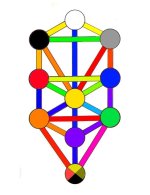
Tree in RGB Space
I've been working on this for several months. The original descriptions of the color scales were for pigments or inks (subtractive red-yellow-blue primaries). Light (additive red-green-blue primaries) combines colors very differently, and there is no consistent, exact way to convert from subtractive RYB to additive RGB (actually it's theoretically impossible). I'm almost where I want to be, trying to keep the chroma as high as possible consistent with the color scales. There's a little more tweaking to be done here and there, but this is where I am right now. __________________ "When choosing between two evils, I always like to try the one I've never tried before." - Mae West |
|
|
|
|
|
Ask a Professional Tarot Reader Top #1 |
|
Ads by Google
via Google Adsense
|
|
| #ADS |
|
Citizen
Join Date: 02 Feb 2006
Location: NSW, Australia
Posts: 4,813
|
I’m a bit confused here; is ‘subtractive’ (decreasing the light wavelength) for inks and dyes (on white background) – RYB, different from ‘subractive’ for printing (CMY)? And if I print your picture (with inkjet printer or photo-chemical printing) CMY + Key (black) = CMYK? Are you saying that now you are trying to convert the colours to additative to represent the aspect of radiated light (increasing the wavelength to make darkness light) - even though it is ‘theoretically impossible’ and if so would not that be CMY like in stage production lighting? Or is there some process with inkjet and photo-chemical production where you start with the basic primaries of RBG (I guess there must be as that’s what you said) for additive? I’m not really up on these new-fangled computer contraptions that use 'light' (?do they) to illuminate a white background with color ![]() Sorry if I am totally confused I just didn’t get the link between. Quote:
Quote:
Quote:
Its an interesting idea though and I am curious to see how it works out as I have encountered a similar (note 'similar') quandry when working the Rites of Eleusis on stage and attempting to project the appropriate colors. __________________ "Do what thou wilt Faustus." Mephistopheles to Dr. Faustus. |

|||
|
|
|
|||
|
|
Ask a Professional Tarot Reader Top #2 |
|
Hermit
Join Date: 21 Dec 2010
Location: USA
Posts: 3,257
|
No big deal. RGB are the light primaries used nowadays, CMY(K) are the correct pigment primaries used in printing. RYB doesn't theoretically work, because, for example, a perfect Y primary + a perfect B primary will make black, not green, because they have no common reflectance of green. Sorry for bringing up the physics of color. My bad. ETA. I'm talking about reproducing colors on a computer monitor. __________________ "When choosing between two evils, I always like to try the one I've never tried before." - Mae West Last edited by LRichard; 03-03-2013 at 10:58. Reason: misprints due to muddleheadedness |
|
|
|
|
|
Ask a Professional Tarot Reader Top #3 |
|
Hermit
Join Date: 21 Dec 2010
Location: USA
Posts: 3,257
|
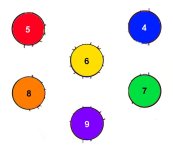
I'm about to give up. Pairs of complementary colors are supposed to be Sephirot 4 and 8 (blue and orange), 5 and 7 (red and green), and 6 amd 9 (yellow and violet). These are approximate (very approximate) complementary colors using the pigment primary colors red, yellow, and blue. However, they are not true visual complementary pairs, such as would be obtained with the subtractive CMY system or its dual, the additive RBG primaries. The only way to fix this is to compromise (*yawn*) by emulating RYB with RBG or by changing the color scales (heresy A few other things work, such as red + blue = violet, and red + yellow = orange. However, blue + yellow does not make green; it makes black in CMY and white in RGB. The only reason it makes green with paints is due to the presence of green "contamination" in almost all blue and yellow pigments. This is all for the project for now, until I manage to claw my way out of the dilemma. __________________ "When choosing between two evils, I always like to try the one I've never tried before." - Mae West |
|
|
|
|
|
Ask a Professional Tarot Reader Top #4 |
|
Citizen
Join Date: 02 Feb 2006
Location: NSW, Australia
Posts: 4,813
|
Good luck! Maybe one day you can explain to me how colors in a color 'band' show frequency numbers (the measure of their wavelength) and by simple maths the color IN that band has the proper frequency in number and posotion [that makes sense] YET; when they show that band as a circle and join the red and violet (through shades of purple and maroon) they show the frequency numbers of THOSE colors as a negative number? How can a wave length be -n long??? __________________ "Do what thou wilt Faustus." Mephistopheles to Dr. Faustus. |
|
|
|
|
|
Ask a Professional Tarot Reader Top #5 |
|
Hermit
Join Date: 21 Dec 2010
Location: USA
Posts: 3,257
|
Quote:
__________________ "When choosing between two evils, I always like to try the one I've never tried before." - Mae West Last edited by LRichard; 05-03-2013 at 12:00. Reason: sp due to hurrying |
|
|
|
|
|
|
|
Ask a Professional Tarot Reader Top #6 |
![]() |
| Bookmarks |
| Thread Tools | |
|
|